

How much brighter are Morimoto XB Evo headlights compared to the original XB models? It’s one of the most common questions we get at Headlight Revolution (see our Morimoto headlight DOT compliance guide), and we decided to answer it the only way we know how: by testing them all, side by side, across multiple vehicles using our multi-point testing system. For context on our testing methodology, see our previous review of Morimoto XB headlights on the Super Duty.
The short answer? Yes, the XB Evo headlights are significantly brighter. But the real story is in the numbers, and they tell a compelling tale about just how far Morimoto has pushed LED headlight technology since the original XB lineup debuted years ago.
How We Test Headlights at Headlight Revolution
Before we dive into the results, it’s worth explaining how we measure headlight performance. At Headlight Revolution, we use the Morimoto multi-point testing system, which evaluates headlights across eight critical measurement points on a wall. We measure six points for low beam and three for high beam, then feed all those numbers into a formula that produces scores for distance zone (how far the light reaches), high beam intensity, and beam width. Each score is on a scale of 1 to 10, and we combine them into a single overall rating.
This isn’t a subjective “it looks brighter to me” comparison. It’s a controlled, repeatable process that lets us give you real numbers so you can make an informed decision. We tested one headlight at a time from the driver side, then installed both headlights on the vehicle for visual comparison shots. With that context in mind, let’s look at what we found across five different vehicles.
Toyota Tacoma (2016-2023): XB vs. XB Evo

The Tacoma comparison was one of the most dramatic we’ve ever recorded. The original Morimoto XB headlight scored a 1.7 on low beam distance, a width score of 2.0, and an overall rating of just 3.8. That’s not terrible by aftermarket standards, but there was clearly room to grow.
When we installed the XB Evo Hybrid, the numbers jumped immediately. Low beam hit 7.0, high beam scored 6.5, width came in at 5.4, and the overall rating landed at 6.8. That’s nearly double the original XB’s overall performance right out of the box.
The full XB Evo pushed things even further with its dedicated D-optic high beam assist. On low beam, it matched the Hybrid at 7.0, but the high beam score rocketed to 9.1 thanks to that third projector. The width score was 5.7, and the overall rating settled at 8.0. For those keeping score, that means the XB Evo more than doubled the original XB’s overall performance rating on the Tacoma.
And then there’s the optional supercharged driver. With that installed on the XB Evo, we measured a low beam of 9.2, a high beam of 11.7, a width score of 7.7, and an overall rating of 9.6. That’s nearly a perfect score on our scale, and it completely redefines what’s possible from an aftermarket headlight for the Tacoma. Keep in mind that the supercharged driver does push the headlights past DOT compliance limits, so it’s recommended for off-road use only.
Dodge Ram (2009-2018): XB vs. XB Evo
The Ram comparison gave us a great baseline because the original Morimoto XB was already a strong performer on this truck. It scored a 7.8 on low beam, 8.3 on high beam, and a width of 3.1 for an overall rating of 5.5. Compared to the OE reflector headlights, which only managed a 2.7 overall, the original XB was a massive improvement.
However, the XB Evo lineup raised the bar in every category. The XB Evo Hybrid scored 6.4 on both low and high beam with a width of 4.0, producing an overall rating of 6.4. The interesting story here is the width improvement. While the original XB had a narrow 3.1 width score, the Hybrid bumped that to 4.0, giving you noticeably more peripheral illumination.
The full XB Evo with its D-optic high beam assist scored 6.7 on low beam and 7.1 on high beam, with a width of 4.1 and an overall rating of 6.9. That makes it the brightest DOT-compliant headlight we’ve ever tested for the 09,18 Ram, period. Furthermore, with the supercharged driver, those numbers climbed to 6.9 low beam, 9.4 high beam, 4.8 width, and a 7.9 overall rating. The high beam performance with the supercharged driver is particularly impressive because that D-optic projector absolutely destroys the darkness ahead of you.
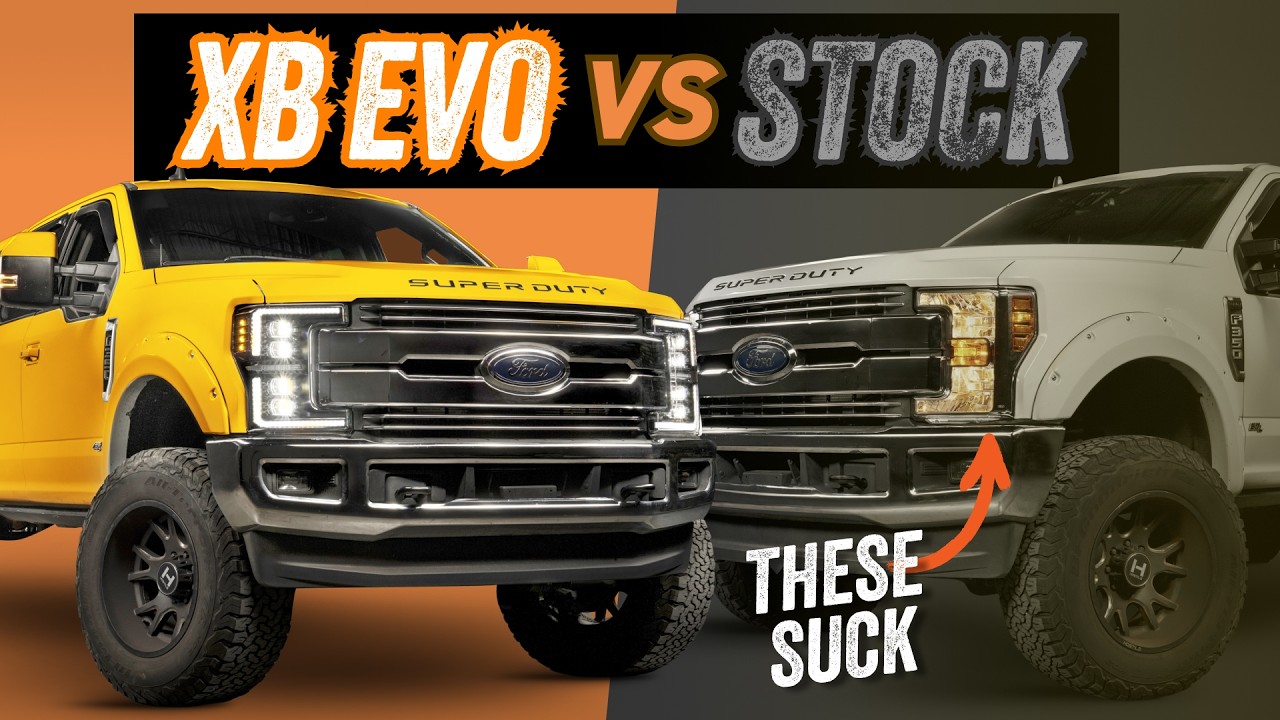
Ford Super Duty (2017-2019): Stock vs. XB Evo
The Super Duty test was especially revealing because we compared the XB Evo to both the stock halogen and the OEM LED headlights. Surprisingly, the factory LED headlights actually performed worse than the halogens in our testing. The stock halogen scored a 3.3 overall, while the OEM LED came in at just 3.1. That’s because the factory LED optics have what we can only describe as a bloblike hot spot with weak gradient that makes it excessively foreground-heavy.
The XB Evo changed the game entirely. On low beam, it scored 6.5. High beam came in at 6.9. The width was 4.8, and the overall rating was 6.9. That’s more than double the stock headlights’ performance. Additionally, the projectors in these headlights use four bi-LED units per side, all driven at about 25% potency to stay within compliance limits. That means there’s substantial headroom for the supercharged driver, which pushed the scores to 7.8 low beam, 10.1 high beam, 6.7 width, and an 8.8 overall rating.
Corvette C6 (2005-2013): Four Generations Compared
The C6 Corvette test was unique because Morimoto has released four different headlight generations for this car, and we tested all of them. The stock HID headlights scored an abysmal 2.0 overall, partly because the HID bulbs lose brightness over time and the reflector bowl tends to burn up from the heat.
The first-generation XB (C7 style) scored a 3.8 overall, and the second-generation XB (C8 style) actually scored lower at 1.8. That might seem counterintuitive, but the C8-style headlight’s aggressive lens angle creates excessive foreground illumination that hurts the usable beam pattern. It’s a good reminder that styling and performance don’t always move in the same direction.
The XB Evo Hybrid brought the score up to 5.0, with a standout width score of 7.3. And the full XB Evo pushed even further to a 5.9 overall, with an incredible width score of 10.5 thanks to its side-shooter LEDs that throw additional light to the left and right. These numbers might seem lower than the truck headlights, but that’s because the C6’s extreme headlight lens angle makes it inherently difficult to create an optimized beam pattern. In that context, a 5.9 represents a massive achievement in optical engineering.
Ford F-150 and Raptor (2009-2014): The Best Gets Better
The 09,14 F-150 has always been one of Morimoto’s flagship vehicles for aftermarket headlights, and the XB Evo takes things to another level. Your stock halogen headlights scored a 2.1 overall, while the OEM HID option (for trucks that had it) managed a 2.7.
Both the XB Evo and XB Evo Hybrid use the same bi-LED projectors and scored identically: 6.9 on low beam, 6.7 on high beam, 4.8 on width, for a 6.8 overall rating. That’s more than triple your stock halogens in a DOT-compliant package.
With the supercharged driver, those scores jumped to 9.4 on low beam, 9.3 on high beam, and 6.7 on width for an 8.8 overall. But here’s where the F-150 XB Evo really separates itself from the pack. The full XB Evo model includes two Morimoto one-banger pod lights inside the headlight housing as auxiliary high beam assists. With those engaged plus the supercharged driver, the high beam score hit an unprecedented 14.3, resulting in a 9.3 overall rating. That is the single highest score we have ever recorded for any headlight on any vehicle at Headlight Revolution.
Why Are the XB Evo Headlights So Much Brighter?
If you’re new to the Morimoto lineup, our guide on why Morimoto XB LED headlights stand apart provides helpful background.
Several engineering improvements explain the massive performance gains. First, the XB Evo uses an entirely new generation of bi-LED projectors designed by Morimoto’s lead optical engineer, Yoshi Ashida. These projectors are powered by the latest automotive-grade Nichia LEDs from Japan and are so efficient that they’re only driven at about 50% of their maximum capacity in stock form to stay within DOT compliance limits.
Second, the XB Evo models feature a dedicated D-optic high beam projector (or one-banger pod lights on the F-150) that provides a dedicated burst of intensity when you switch to high beams. The original XB headlights relied solely on their bi-LED projectors for both low and high beam, which meant compromises in both modes.
Third, the projector alignment strategy has changed. Rather than optimizing for a crisp cutoff at 25 feet from a wall, the XB Evo projectors are calibrated to converge at roughly 30 meters, which is where you actually need the light when driving. This means the beam pattern might look unusual up close, but on the road, everything merges into one powerful, wide, and evenly distributed field of light.
Beyond Brightness: Features That Set the XB Evo Apart
While brightness is the headliner, the XB Evo brings several additional improvements that are worth noting. The frost-free heating system (available on the full XB Evo models) warms the lens surface to prevent ice and frost buildup in cold weather. You activate it by flashing your high beams four times when the temperature drops below 41°F. This is something no other aftermarket headlight manufacturer offers.
The signal swap system lets you customize your daytime running light color (white or amber) and turn signal style (sequential or fade-off) using simple plug-and-play keys on the back of the headlight. Furthermore, the DRL optics use a specialized surface texture that maintains consistent brightness from any viewing angle, which is a significant upgrade over the original XB’s DRL that tended to wash out at certain angles.
Additionally, a new UV-resistant hard coating on the lenses exceeds even Toyota’s industry-leading standards, so yellowing and cracking over time should be a thing of the past. All of this is backed by Morimoto’s 5-year warranty.
The Verdict: How Much Brighter Are XB Evo Headlights?
Across every vehicle we tested, the XB Evo headlights delivered substantial brightness improvements over the original XB lineup. Here’s a summary of the overall ratings:
| Vehicle | Original XB | XB Evo (DOT) | XB Evo + SC Driver | Improvement |
|---|---|---|---|---|
| Toyota Tacoma | 3.8 | 8.0 | 9.6 | +111% |
| Dodge Ram | 5.5 | 6.9 | 7.9 | +25% |
| Ford Super Duty | N/A* | 6.9 | 8.8 | 2x stock |
| Corvette C6 | 3.8 | 5.9 | , | +55% |
| Ford F-150 | N/A* | 6.8 | 9.3† | 3x stock |
*No original XB model existed for this vehicle; comparison is to stock headlights. †Includes one-banger auxiliary high beams.
The bottom line is clear: whether you’re upgrading from stock headlights or from the original Morimoto XB, the XB Evo delivers a measurably brighter, wider, and more refined beam pattern that makes nighttime driving safer and more comfortable. The technology improvements in projector design, LED efficiency, and optical engineering are real, and our testing proves it across every vehicle we measured.
Ready to see the difference for yourself? Browse the full Morimoto XB Evo headlight lineup at Headlight Revolution and find the right fit for your vehicle.
Source Videos
All testing data in this article comes from our hands-on review videos. Watch the full comparisons:
- Tacoma XB Evo Brightness Test
- Ram XB vs XB Evo Head-to-Head
- Super Duty XB Evo Review & Light Output
- Corvette C6 XB Evo Install & Review
- F-150 XB Evo Complete Review
Frequently Asked Questions
Are the Morimoto XB Evo headlights DOT compliant?
Yes, all Morimoto XB Evo and XB Evo Hybrid headlights are fully DOT compliant and meet FMVSS 108 regulations for on-road use in their stock configuration. However, if you install the optional supercharged driver, the headlights exceed allowable intensity limits and are recommended for off-road use only. You can easily revert to the stock driver at any time to restore compliance.
What is the difference between the XB Evo and the XB Evo Hybrid?
Both models use the same bi-LED projectors and produce identical low beam and high beam output. The full XB Evo adds a dedicated D-optic high beam assist projector, the frost-free heating system, customizable DRL color via signal swap keys (white or amber), a startup animation sequence, and titanium-accented interior shrouds. The Hybrid offers a white-only DRL with a fade-off turn signal at a more affordable price point.
Can I upgrade from the original Morimoto XB to the XB Evo?
Absolutely. The XB Evo is a direct bolt-on replacement that uses the same mounting points and factory connectors as the original XB. All necessary adapter harnesses are included in the box, so installation is straightforward. Many customers who owned the original XB have upgraded and reported dramatic improvements in both brightness and feature set.
What does the supercharged driver do and is it worth it?
The supercharged driver replaces the stock LED driver on the back of the headlight and boosts projector intensity by approximately 30,50%. Since the projectors are only driven at about 50% capacity in stock form for compliance reasons, the supercharged driver unlocks their full potential. On the Hybrid model, it also enables the startup animation sequence. It does make the headlights non-compliant for street use, but many owners consider it a must-have upgrade for the dramatic brightness improvement.
How does the frost-free heating system work?
Available on the full XB Evo models (not the Hybrid or XRGB), the frost-free system uses an integrated heater that warms the internal surface of the headlight lens to prevent frost and ice buildup. When the ambient temperature drops below 41°F (5°C), you activate it by flashing your high beams four times. The headlight will flash back twice to confirm activation. If it only flashes once, conditions aren’t met (possibly not cold enough). The system automatically maintains the lens temperature to keep your headlights performing in winter conditions.
Meet the Experts Behind Headlight Revolution

Chris Nelson – Founder
Before founding Headlight Revolution in 2011, Chris worked as an automotive install technician specializing in lighting, sound systems, and engine performance parts. He has personally tested thousands of lighting products and works directly with lighting engineers to evaluate the technical performance behind every recommendation.

Josh Beberg – Content Production Manager
Josh leads hands-on testing and content production at Headlight Revolution. From beam pattern comparisons to real-world installations, he works directly with lighting engineers to ensure every review is grounded in measured results, not marketing specs.


