

Everything You Need to Know About T10 Bulbs
Do you know what a T10 bulb is? It’s one of the most common bulbs in modern vehicles. You’ll find it in dome lights, map lights, glove boxes, license plates, doors, cargo lights, and sometimes reverse lights.
However, upgrading to LED confuses many people. You might see part numbers like 194, 168, T10, T15, 912, or 921. They look different on paper. In reality, many share the same base.
This guide breaks it down clearly. We’ll explain:
-
What a T10 really is
-
How it compares to T5 and T15
-
Why one LED can replace many part numbers
-
What to buy for your application
If you want the short answer: the XENONDEPOT XTR T10 and the GTR 6 LED CANBUS T10 are safe bets. Now let’s explain why.
Understanding Mini Wedge Bulb Types
When you pull a bulb out of your vehicle, you’ll usually find one of three wedge styles:
-
T5 (smallest)
-
T10 (most common)
-
T15 (larger version)
T5 Bulbs
T5 bulbs are tiny. They don’t draw much power. They don’t produce much heat. Because of that, almost any quality T5 LED replacement will work fine.
You don’t need to overthink T5 upgrades.
T10 Bulbs (The Most Common)
T10 bulbs include part numbers like:
194, 168, 147, 152, 158, 159, 161, 192, 193, W5W
They all share the same wedge base. The only real difference between them is wattage.
For example:
-
A 168 draws more wattage than a 194
-
Higher wattage = slightly brighter incandescent bulb
However, when you switch to LED, wattage differences no longer matter. One quality T10 LED replaces all of them.
That’s why a single LED T10 works across multiple part numbers.
It All Comes Down to Wattage (With Incandescent)
Manufacturers choose incandescent wattage carefully. A glove box light uses lower wattage to reduce heat. A license plate light might use something brighter.
However, LEDs run cooler. Therefore, you don’t have to worry about heat the same way.
That’s why one LED T10 can replace many incandescent versions safely.
T10 vs T15: What’s the Difference?

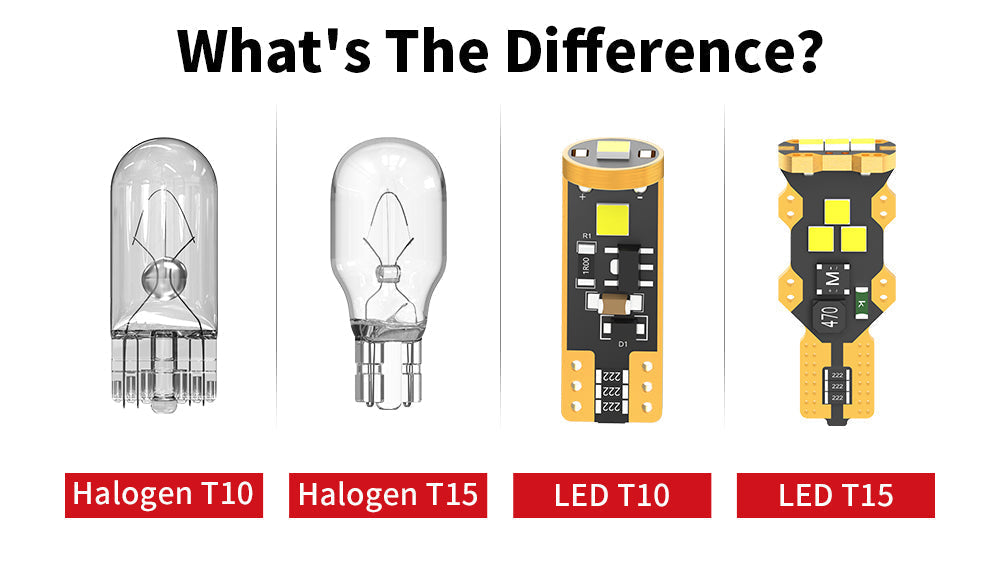

The T10 and T15 share the exact same wedge base.
The difference?
-
T15 is physically larger
-
T15 typically produces more light
-
T15 works best in larger housings
You’ll usually find T15 bulbs in:
-
Reverse lights
-
Cargo lights
-
Larger interior housings
If you pull out a T10 and have room for a T15 LED, upgrade to the T15. It will produce more light.
However, if space is tight, stick with a T10.
Choosing the Right LED Style
Not all T10 LEDs are built the same. The design affects performance.
There are three main LED styles:
Forward-Facing LEDs
All chips point in one direction.
Best for:
-
Directional cargo lights
-
Focused lighting
Example: GTR Lighting Carbide Series
However, these can be too bright for small interior spaces.
Side-Facing (Left & Right)
LEDs mount on the sides only.
Best for:
-
Dome lights
-
Map lights
-
Reflector-based housings
Some cheap versions use exposed circuit boards. Those often fit poorly or fail early. Therefore, buy from reputable brands.
Also, too many tiny chips can create uneven shadows. Better-designed bulbs use diffusion to prevent that “disco light” effect.
360-Degree Output
These shine in all directions.
High-quality versions include:
-
GTR Lighting 6 LED CANBUS T10
-
Well-spaced chips
-
Proper heat sinking
-
Strong internal connections
Cheap versions pack too many LEDs in tight spaces. As a result, they overheat or burn out quickly.
Heat management matters.
Low Profile T10 for Tight Spaces
Many vehicles have extremely tight housings. Large LED replacements won’t fit.
In those cases, the GTR Low Profile T10 works best.
It:
-
Fits tight license plate housings
-
Avoids clearance issues
-
Prevents broken circuit boards
However, don’t use low-profile bulbs in reverse light applications. They’re not bright enough.
Why Connection Quality Matters
Look at the metal contacts on the back of the bulb.
High-quality bulbs use:
-
Thick, wide contact blades
-
Strong spring tension
-
Durable materials
Cheap bulbs use:
-
Thin wire contacts
-
Weak solder joints
-
Poor fitment tolerances
Loose contacts cause flickering. Weak boards crack during install.
That’s why the XENONDEPOT XTR T10 stands out. It uses a ceramic body and durable contacts that closely match OEM design.
T15 Bulb Considerations


When upgrading T15 bulbs for reverse or cargo lights, brightness becomes critical.
GTR Carbide T15
-
360° output
-
Proper heat dissipation
-
Built-in thermal protection
If the bulb gets too hot, it dims slightly instead of failing. That’s smart engineering.
XENONDEPOT Ceramic T15
This design takes a different approach.
It:
-
Uses one powerful LED
-
Reflects light through a conical reflector
-
Mimics OEM beam patterns
Instead of flooding the housing with chips, it focuses light intelligently.
That’s why it performs so well.
Avoid Cheap “CANBUS” Amazon Bulbs
You’ve probably seen the plus-shaped T15 bulbs online.
They look bright. However, they expose delicate components. Moisture can ruin them. Oversized boards often scrape during installation.
Moreover, many don’t match OEM dimensions properly.
Fitment matters just as much as brightness.
Final Recommendations
If you want something that simply works, here’s the breakdown:
For Tight Spaces
GTR Low Profile T10
For Left/Right Applications
Morimoto T10
For Small but Very Bright
GTR Carbide T10
Best Overall Plug-and-Play
XENONDEPOT XTR T10
For CANBUS-Sensitive Vehicles
GTR 6 LED CANBUS T10
Brightest Reverse Option
GTR High Output LED Reverse Light (T15)
Final Thoughts
T10 and T15 bulbs confuse people because of part numbers. However, once you understand the base design, everything makes sense.
Focus on:
-
Fitment
-
Heat management
-
Contact quality
-
Intended light direction
Choose a quality brand, and you won’t deal with flicker, failure, or poor performance.
Upgrade once. Do it right.
If you are more of a visual learner, be sure to check out our video going over the various D3S bulb options out there. While you are there, be sure to like and subscribe to our channel for the latest upgrades for your vehicle. Also, do not forget to check out our wide range of bulb options on HeadlightRevolution.com.
Up Next:
Is Headlight Revolution Legit? The Truth About Our Reviews, Testing, and Lighting Recommendations
Meet the Experts Behind Headlight Revolution

Chris Nelson – Founder
Before founding Headlight Revolution in 2011, Chris worked as an automotive install technician specializing in lighting, sound systems, and engine performance parts. He has personally tested thousands of lighting products and works directly with lighting engineers to evaluate the technical performance behind every recommendation.

Josh Beberg – Content Production Manager
Josh leads hands-on testing and content production at Headlight Revolution. From beam pattern comparisons to real-world installations, he works directly with lighting engineers to ensure every review is grounded in measured results, not marketing specs.


